
 Written by admin
 July 2026 Medicare Changes: What They Mean for GP Provider Numbers, DPA and the 19AB Moratorium
The 1 July 2026 Medicare changes have landed, bringing with them a 2.6% MBS indexation, a new digital assignment of benefit process, and a mandatory My Health Record upload requirement for pathology and diagnostic imaging reports. For the thousands of GP practices across Australia — particularly those in Distribution Priority Areas (DPA) and Modified Monash Model (MMM) regions — these changes sit alongside an already complex landscape of Section 19AB and 19AA restrictions that govern who can access a Medicare provider number and where.
What Actually Changed on 1 July 2026?
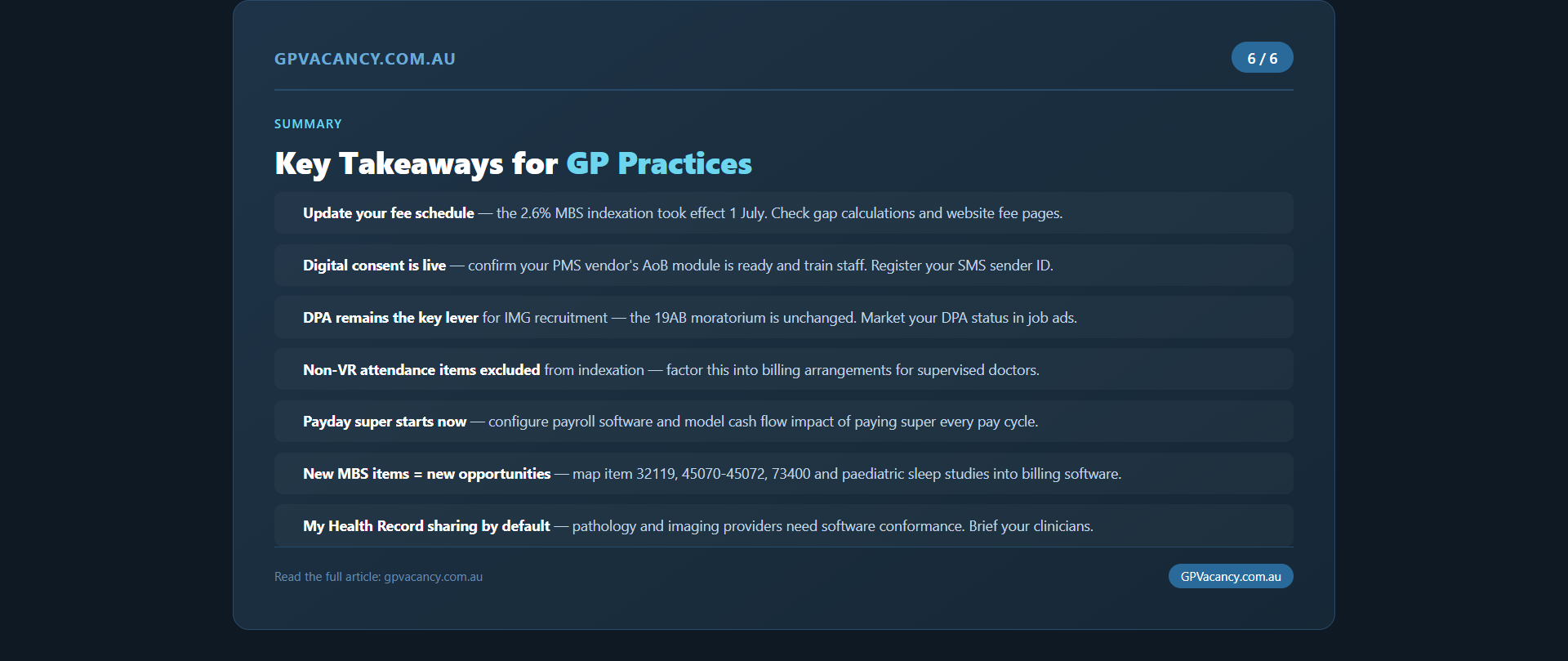
The headline change is the 2.6% indexation applied to most general medical services, diagnostic imaging, and pathology items. The RACGP was quick to point out that this falls well short of general CPI (4.2%) and health CPI (4.0%), meaning practices in real terms are going backwards. Attendance items for doctors without vocational registration are excluded from the uplift — a detail that directly impacts non-VR GPs and IMGs working under supervision in DPA areas.
The new digital assignment of benefit (AoB) process is arguably the biggest workflow shift. Patients can now give bulk billing consent via an SMS or email link, the GP co-signature requirement has been removed, and consent can be collected before or after the attendance. Signed agreements must be retained for two years, though paper forms remain a permanent fallback option. This is a significant change for practices in DPA and rural areas where patient volumes and administrative burdens are already high.
How Does This Connect to 19AB, 19AA and DPA?
Section 19AB of the Health Insurance Act 1973 restricts overseas-trained doctors (OTDs) and foreign graduates of accredited medical schools (FGAMS) from accessing Medicare benefits unless they work in a Distribution Priority Area (DPA) for ten years — the so-called “10-year moratorium.” Section 19AA similarly restricts specialist Medicare access for IMGs who haven’t gained specialist recognition with AHPRA.
The 2.6% indexation is the same for every practice regardless of location, but its impact is felt more acutely in DPA and MMM 2–7 regions, where recruitment is harder, patient demographics are often more complex, and practice overheads can be higher relative to billing volumes. When a practice in a metropolitan area can adjust private fees to cover the gap between indexation and real costs, a mixed-billing practice in a DPA region has less room to move — because many of their patients are bulk-billed.

New MBS Items and What They Mean for GP Recruitment
Several new MBS items commenced on 1 July 2026, including standalone colonoscopy item 32119, developmental breast abnormality items 45070–45072, and HLA hypersensitivity testing item 73400. For GP practices looking to recruit, the expanded MBS item set creates more opportunity for practices to offer diverse services — a factor that can make a rural practice more attractive to a potential GP hire.
What This Means for Practices Recruiting GPs
For practice owners and recruiters using gpvacancy.com.au and gpjob.au, the July 2026 changes reinforce several important dynamics. First, the gap between indexation and real cost inflation makes the “right” billing model even more critical when positioning a role — candidates increasingly ask about billing percentages and patient mix during interviews. Second, the new AoB process means practices need their admin workflows sorted before taking on new GPs, particularly in high-volume settings.
Third, for IMGs and OTDs bound by the 19AB moratorium, DPA classification remains the single most important factor determining where they can work and access Medicare rebates. The DPA system has been reviewed multiple times in recent years and is expected to see another makeover, but as of July 2026, the 10-year moratorium itself remains firmly in place — despite ongoing advocacy from peak bodies to reduce or replace it with a more targeted model.
Beyond Medicare: Payday Super, DVA and NDIS
Practices also need to be aware of the non-Medicare changes that landed on the same date. Payday superannuation — requiring employers to pay super at the same time as wages rather than quarterly — adds a cash flow and payroll compliance layer. DVA compensation assessment fees received their first annual 1 July indexation. For practices in DPA and rural regions that often see a higher proportion of DVA and NDIS patients, these changes add to the administrative load that can already be a barrier to GP recruitment and retention.
This article draws on reporting from ClinicComply and the Department of Health, Disability and Ageing. Read the original guide on the 1 July 2026 Medicare changes here: ClinicComply — Medicare Changes 1 July 2026: What GPs and Practices Must Know.