
 Written by admin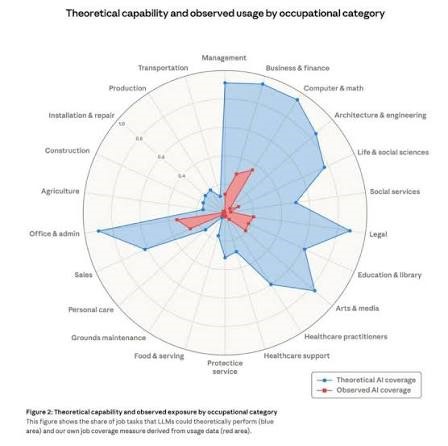
New Anthropic Study Reveals Where AI Actually Impacts Healthcare Jobs — and Where It Doesn’t

A major new study from Anthropic — the company behind Claude AI — has mapped the gap between what artificial intelligence could theoretically do to healthcare jobs, and what it is actually doing today. The research, titled “Labor Market Impacts of AI: A New Measure and Early Evidence,” introduces a framework to track how AI is reshaping employment across 22 occupational categories, including both Healthcare Practitioners and Healthcare Support roles.
The Radar Chart in Plain English
The striking radar chart from the study shows two layers. The large blue area represents “theoretical AI coverage” — the share of job tasks that an LLM could, in principle, complete at least twice as fast. For Healthcare Practitioners, that blue area extends far out toward the chart’s outer edge, meaning a significant portion of clinical documentation, prescription management, and administrative tasks are theoretically automatable.
The small red area, clustered near the centre, tells a different story. This is “observed AI coverage” — the tasks people are actually using AI for in professional settings, measured through millions of real Claude conversations. For healthcare, the red area is tiny, revealing an enormous gap between what AI can do and what it is actually being used for in medical contexts.
Where Does Healthcare Sit?
Healthcare Practitioners (doctors, nurses, allied health professionals) and Healthcare Support (orderlies, assistants, technicians) sit in very different positions on the chart compared to occupations like Computer Programming (75% observed coverage) or Data Entry (67%). The study found that 30% of all workers have zero observed AI coverage — and many hands-on healthcare roles fall into this category. Tasks like physical examination, performing procedures, patient handling, and direct care remain firmly outside AI’s current reach.
Interestingly, the study specifically mentions that the task “Authorize drug refills and provide prescription information to pharmacies” scores the maximum theoretical AI exposure rating (β=1), meaning it could be fully automated. Yet Anthropic’s data shows almost no observed usage of Claude for this task in practice — a gap the researchers attribute to legal constraints, verification requirements, and slow institutional adoption in healthcare settings.
Who Is Most Affected by AI — And What It Means for Healthcare Recruiting
The study identifies a striking demographic pattern: workers in the most AI-exposed professions are 16 percentage points more likely to be female, 11 points more likely to be white, and earn 47% more on average. They are also almost twice as likely to hold graduate degrees. This profile aligns closely with healthcare practitioners — a highly educated, predominantly female, well-compensated workforce.
Despite the theoretical exposure, the study finds no systematic increase in unemployment for highly exposed workers since late 2022. However, it finds suggestive evidence that hiring of younger workers (aged 22-25) into exposed occupations has slowed by approximately 14%. For GP recruitment, this raises an important question: as AI automates more administrative tasks in healthcare, will we see fewer junior administrative roles in clinics, even as demand for clinical GPs continues to grow?
What This Means for GP Practices and Recruiters
For GP practices in Australia, the takeaway is nuanced. AI’s theoretical ability to handle prescription management, clinical documentation, and patient communication is well established. But the reality is that adoption in healthcare remains slow due to privacy regulations (including Australian privacy law), the need for human verification, and the complexity of medical decision-making.
The study’s key insight — that theoretical capability and real-world adoption are very different things — is especially true in healthcare. While AI can help with triage, summarisation, and admin, the hands-on, empathetic, and legally accountable nature of medical work means that GPs remain irreplaceable. The most likely scenario is that AI becomes a powerful tool for reducing the administrative burden on doctors, potentially improving job satisfaction and retention — rather than replacing clinical roles.
For those recruiting GPs, the message is clear: highlight how your practice leverages technology to reduce admin, not replace doctors. This is a genuine selling point for GPs who are tired of paperwork and want to focus on patient care.
This article draws on research from Anthropic — read the original study here: Labor Market Impacts of AI: A New Measure and Early Evidence.